Evergreen Cemetery
by peter_gordon
-
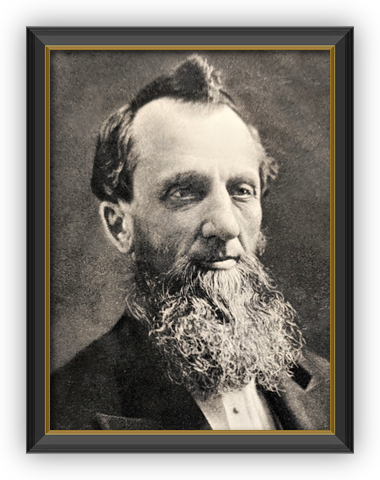 Thomas Chatfield
 was born at Great Barrington, Mass. He came to Owego in 1839 as a baker and worked as a journeyman until he entered the grocery business, in which he continued until a short time prior to his death in 1884. Mr. Chatfield was a prominent and public-spirited citizen. He served four years as a Village Trustee, and three years as Owego Supervisor. In 1853, he represented Tioga County in the NY State Assembly. Chatfield was also President (Mayor) of the Village of Owego in 1868, and was a candidate for NY State Treasurer in 1869. He was a NY State Senator, in 1871—72 and Treasurer of the Tioga County Agricultural Society, for many years. He had one son, T. I. Chatfield, Jr. His brother John’s mansion at 44 Front was demolished to make way for the Gurdon Pumpelly Mansion now a popular wedding venue, B & B and Event Center. He married Lucy Benton Goodrich 1830-1903 who moved to 337 Front Street after his death.
-
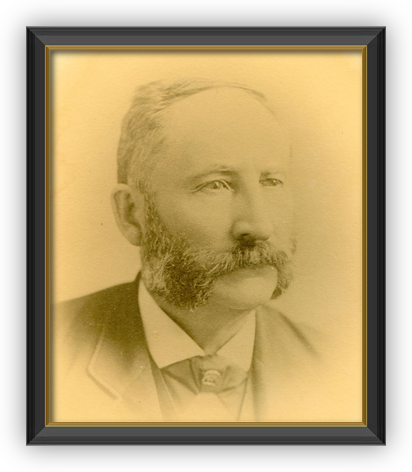 Charles Martin Haywood
Charles Haywood was born in Vermont, where he learned to cut and finish marble at age 16. In 1856, at Littleton, N. H., he went into business for himself. In 1860 he moved to Owego and opened his marble and granite business, with a branch in Waverly. Successful, in 1875 he built, at 80 North Ave. one of the best brick commercial blocks in the village. He was very involved in the International Order of Odd Fellows, Knights and Ladies of Honor, and Masonic activities gaining high office. Among the many civic offices he held were; 1877 Town Supervisor, 1871 Village Trustee, 1872 Village President (re-elected three times), and in 1876 Fire Chief. In 1873, as President of the Owego Steamboat Company he oversaw the building of the Owego, a pleasure steamboat, and the opening of Hiawatha Grove on the Big Island as a recreational destination. Mr. Haywood married Hannah Kneeland, of Proctorsville, Vt., in 1854. His son would succeed him in the firm. The firm of Haywood & Baldwin’s most notable commission was the Tioga County Soldiers & Sailors Monument, dedicated July 4, 1891, on the South end of the Courthouse park. Made from Barry VT Granite, it features a 16.5ft square base with a column rising 50ft high topped by an 8.5ft color bearer. Interestingly Haywood’s own monument in Evergreen is a white-bronze Grecian figure, one of only two bronze monuments in the cemetery.
-
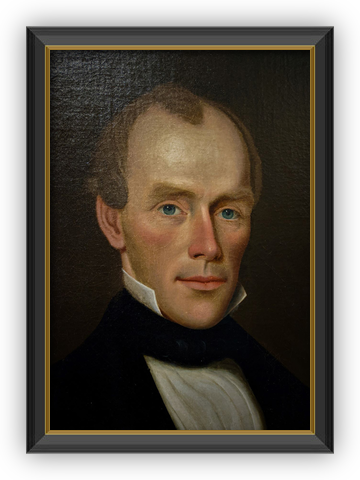 John R. Drake
 was the son of Rev. Reuben Drake, who was a direct descendant of English hero, Sir Francis Drake, through Abraham Drake, who came to America on the ’Mayflower.’ John was born in Orange County, NY, and came to Owego in 1809. He bought large tracts of land, and for several years was manager of the Coxe Patent. He opened a store on Front St. where the bridge now stands. Eventually he owned nine successful store buildings, all of which burned in the Great Fire of 1849. He was a major lumber dealer and built the first dock in Owego and the first stone sidewalk in front of his businesses. He was Judge in the Court of Common Pleas of Broome County (1815-1823) and Tioga County (1833-1838.) He was a Member of Congress (1817-1819), a NY State Assembly Member (1834), and Owego Village President (Mayor) 1841-1845, inclusive. It’s also said that he was the first resident to possess a two-horse carriage and covered sleigh. Drake was very involved in public projects. He was a strong advocate for bringing the NY and Erie Railroad to Owego, donating nine acres of his farm to the Erie Railroad Company. He had a map made and lithographed called, ’ A Map of Drake’s Reservation in the Village of Owego.’ On this map, his entire property was laid out into squares and streets. It was his intention to build up the village on ’the Flats,’ but a paralytic stroke ended his plans before completion. Several “Flats” streets, such as Adeline and Delphine, are named for his daughters.
-
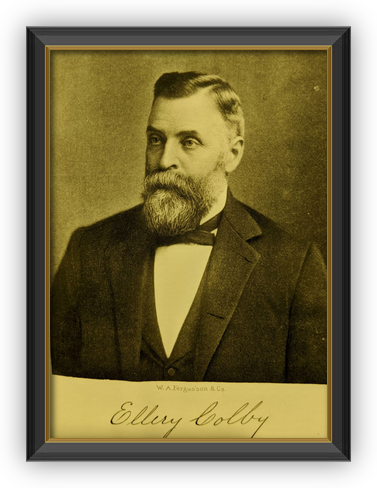 Ellery Colby
Born near Litchfield, CT, Ellery Colby, was the son of a farmer and mechanical inventor with little formal education. From age nine to twenty-two he lived with an uncle, managing a 1,300-acre farm, in Fabius, Onondaga County. He moved to a farm in Groton, NY, married Hattie E. Cornwall, and continued farming until 1875, when he took up bridge building. He inherited his father’s mechanical genius, securing two bridge design patents for bridge trusses and pile foundations. Forming the Groton Bridge Company, he took orders, built bridges, and eventually his annual revenue reached $500,000. In 1891 he sold the company and in 1892 with Frank, Henry, L. S. and son Ray Colby established the Owego Bridge Company on North Avenue. The business thrived and was a leading industry in Owego. The 1893 Court Street Bridge was built by the Owego Bridge Works. In Binghamton, the Exchange Street bridge, still in use today, is an Owego Bridge Co. structure. The iron skeleton for the Tioga County Courthouse was also built by the Owego Bridge Co. In 1907 heavy trucks from the bridge works were rented to haul the large granite blocks, too heavy for horse teams, up the steep road to and in Evergreen to build the Curtis mausoleum. The Open-Door Mission on the Northern edge of Owego now occupies some of the bridge works buildings. Colby’s fine home can still be seen at 97 Front Street in the Village Historic District.
-
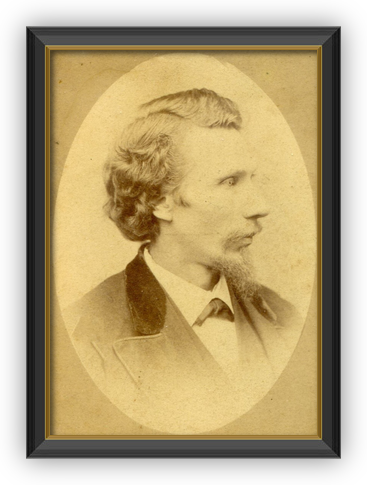 Andrew Burgess
 was born in Washington County. Andrew would work for famous Civil War photographer Matthew Brady eventually becoming his partner and manager of his Washington, DC gallery. Brady sent Burgess to Mexico in 1864 to capture images of the Mexican Revolution. His portrait (shortly before his execution by Benito Juarez) of Archduke Ferdinand Maximilian, Emperor of Mexico, was one of his best-known works. In 1870 he traveled to Sicily with the US Coastal Survey, as a photographer, to capture images of a solar eclipse on December 22, 1870. In 1871 he married, Eudora Tiffany in the Owego Presbyterian Church. He would later turn his attention to gun design, becoming the second most prolific gun designer, after John Browning in American history. Famous gun manufacturers Colt, Marlin, Whitney, and Remington all produced Burgess-designed weapons. The Colt-Burgess 1883 rifle is still a collector’s favorite. With financial support he would open his own factory, the Burgess Gun Company, in Buffalo to manufacture a folding shotgun which could be carried in a holster. One story says a Burgess salesman drew his holstered shotgun from beneath his coat and fired blank rounds into the ceiling of the NY City Police Commissioner Teddy Roosevelt’s office. It is said Teddy was so impressed he bought a number of the guns for the NYC Police Department. After marrying Eudora, the couple lived in her family home on Glenmary Drive in Tioga.
-
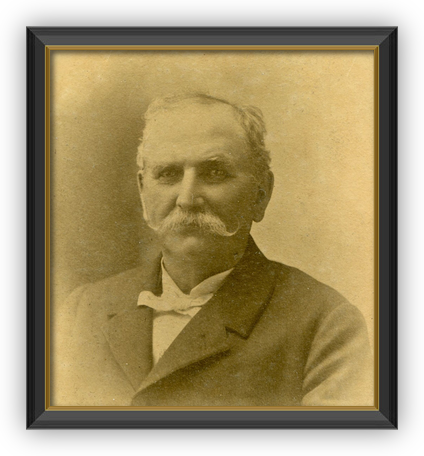 Ephraim H. House
 was brought up on a farm in New Jersey, and at twenty-one learned carpentry. About 1855 he was employed in the car department of the NY and Erie Railroad. He came to Owego in April, 1857, and took charge of the Erie Road’s car-repair shop. In 1860 he became foreman of the bridge shop until 1877 when he began a coal business, House & Co. and farmed extensively. He was a Village Trustee in 1868, 1869, 1873, 1883, and 1884, and Village President in 1874. He was Chief Engineer of the Owego Fire Department in 1873 and 1874. Mr. House married Kate E. Brown with whom he had three children. House would become known as the “Hobo King” of Owego after he instituted a significantly improved scheme to care for indigents. In 1897 he opened a “tramp house” on North Avenue above the Erie Railroad tracks. The building had twenty beds and offered two meals, for which the Village paid 25 cents a day. This was a substantial savings for the Village over their jail-based manner of dealing with the homeless. Word of free lodging and good meals had the undesirable effect of drawing more Hobos to the Village. “Hobo” was a euphemism for the homeless, predominantly men, who hopped free rides on freight trains, lived on handouts and earned money from menial labor. House ended the operation and sold the building after only a few months.
-
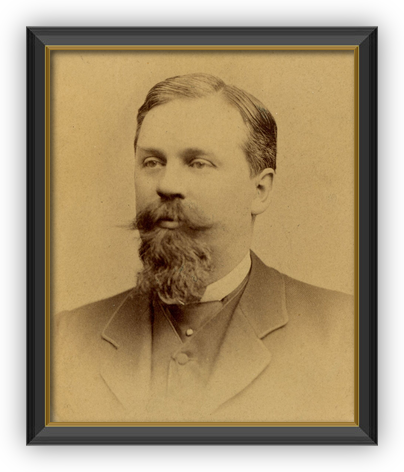 A. Chase Thompson
 was the co-founder (with his father-in-law George Truman) and manager of the Standard Butter Co., of Owego, one of the largest industries of its kind in the world. Thompson was a native of Tompkins County, who came to Owego in 1865. In 1868 Thompson married Sarah F. Truman, the daughter of merchant and banker George Truman, of Owego. Until 1888 he worked with George Truman in his dry-goods business. That spring in company with Truman, Thompson began the manufacture of a superior grade of butter. The Standard Butter Company product found ready sale in the best hotels and restaurants especially in New York City. Their annual sales reached 3,000,000 pounds of butter, as well as shipments of cream and milk. In 1896 they opened a dry-curd factory making 300,000 pounds out of previously discarded materials. The firm had branches throughout Tioga County. When the firm incorporated in 1899 the directors included Thompson as president, L.T. Stanbrough (another Truman son-in-law) as lawyer, and his wife Sarah as Treasurer.
-
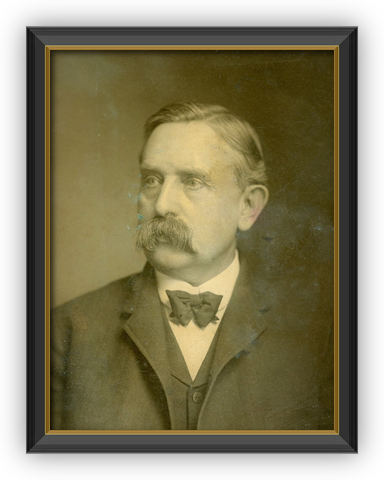 Frank M. Baker
Frank Baker graduated from Owego Academy and attended a business school in Syracuse. His father was a carpenter but Frank didn’t want to work in that trade. Baker clerked for the Erie Railroad at Owego and married Mary McQuigg in 1871. In 1872, the Southern Central Railroad hired Baker as a Station Agent in the Owego Depot. Baker was very active in local and professional affairs. He served on the Village Board (1874-1880) and as Mayor (1877) and on the Owego School Board for three years.
He was Board President of the Owego Fire Department, and Fire Chief (1881). He helped organize the NY State Firemen’s Association and was Secretary (1874-1884) and President (1884, 1885).
He helped found the NY State Firemen’s Home in Hudson, NY. In 1893, Frank helped establish the Central NY Volunteer Firemen’s Association and was its President.
Senator Tom Platt hired him as General Superintendent of the Addison and Northern Pennsylvania Railway Company.
He also worked for the Darien and Western Railroad and was asked by NY Governor Levi P. Morton to head NY’s delegation at the Cotton States International Exposition in Atlanta and was subsequently appointed twice as a Railroad Commissioner for NY State. In 1907 he lost a leg in a railroad accident. In Owego Frank invested in a variety of projects. In 1895, Frank and his son George bought into the hardware business with George S. Chatfield who died right after the deal. Frank bought him out and operated it as Frank M. Baker and Son.
-
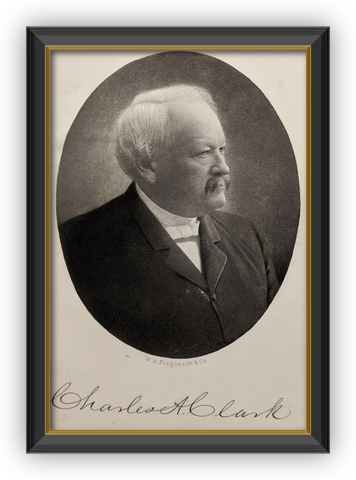 Honorable Charles A. Clark
was the grandson of a drummer boy at the Battle of Bunker Hill. The Honorable Charles A. Clark served for 12 years (1872-1874) as County Judge of Tioga County, NY. A true “Renaissance Man” he served as a school teacher and district superintendent; practiced medicine and surgery with an MD earned at the University of Michigan, operated several mercantile businesses and eventually studied law in the Oneonta, NY office of General S.S. Burnside. Retiring from the bench, he formed a law practice with his son, H. Austin Clark. Judge Clark also served as Vice President of the Tioga National Bank and as an Elder of the First Presbyterian Church of Owego. His first marriage to Evelyn Hodge resulted in two children, H. Austin and Emily Lucretia. Upon Evelyn’s death, Charles married his next-door neighbor, Celestia Arnold, widow of Captain Thomas A. Arnold a casualty of the Civil War. You can walk by the Clark’s elegant Victorian home at 244 Main Street and imagine this remarkable man walking downtown to work each day.
-
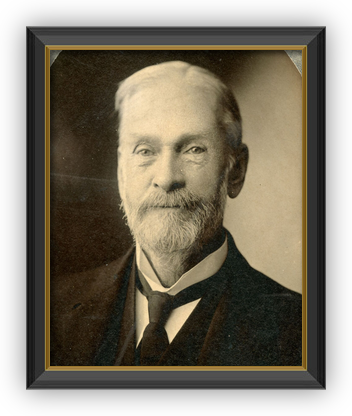 Dr. John Blake Stanbrough
 was born in Montgomery, NY. He began his dental practice in 1851 in the town of Union before moving to Owego in 1854 where he practiced until 1859. In 1860 he married Adeline Truman, daughter of Lyman Park and Emily Goodrich Truman. In August 1862 in Orange County he raised a company of infantry and was elected First Lieutenant. They mustered on September 10,1862 as part of Company I, of the 124th NY Volunteer Infantry Regiment. He was discharged November 12, 1862 due to disabilities. He returned to Owego in 1864 as part owner of Bean, Stanbrough & Holdridge, Hardware dealers. Later with Edwin Stratton he created Stanbrough & Stratton on Front Street until 1879 when he bought out his partner. In 1895 he began selling stoves and water heaters exclusively. He was a member of the Board of School Commissioners/Board of Education, Tioga County Loan Commissioner, a Trustee of the Binghamton State Hospital among other civic occupations. The brick mansion he had built at 309 Front St., next door to his father-in-law, Lyman Park Truman, would later be used for Saint Patrick’s School. The expanded mansion still stands today.
-
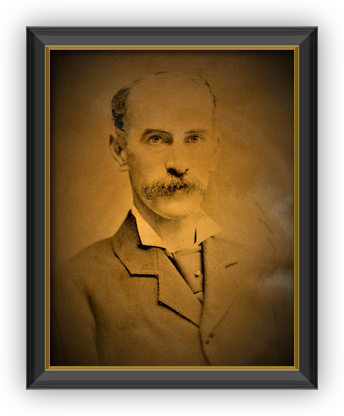 Charles P. Starr
 was an Owego jeweler for over forty years. Starr began his career as an engraver for other jewelers. After the Civil War, he opened a shop at the corner of Lake and Front Streets. He would occupy several locations on Lake Street, and had several partners. In the 1870’s he partnered with John E. Goodrich at 29 Lake Street, then alone again as C. P. Starr, 15 Lake. In 1889, the business became known as Starr and West. Grant M. West, was the former Halsey Valley, Postmaster. In addition to jewelry, the firm sold sterling silver flatware and polish. When Starr died in 1907, Owego merchants closed their shops for the hour of his funeral. Starr’s funeral was one of largest ever held in Owego. His wife Mary, and son, Charles D. carried on his business after his death, eventually at 15 Lake St. After World War I his son partnered with former competitor Charles L. Decker, carrying on into the 1930’s and then on his own until his death in 1948.
-
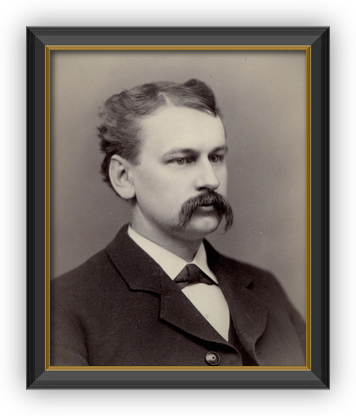 George Alonso King
 was President of the W. H. King & Sons Harness Co., incorporated in February of 1896 with initial capital of $40,000. The firm had its roots in John W. L’Amoureux’s (1832-1880) custom harness shop which was sold (1881) to the firm of King & Co., whose principals were George Alonso’s father Reverend W. H. King, his brother W. A. King, and George Alonso. The firm operated from a three-story building on Lake Street and employing 75 men from 1883 to 1887 manufacturing harness on a large scale. In 1887 the firm built a larger factory. W. A. King retired in 1888, and George Alonso led the firm thereafter and became president in 1896. He married Leonora Dean (1849-1917). Their daughter, Helen Dean King, became one of the most important American biological scientists of the early 20th Century.