Winslow Homer Gallery
by smalltown360
-
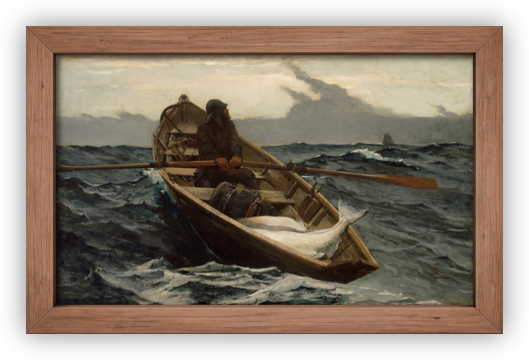 The Fog Warning
A fisherman rows his dory across the open sea. There is no storm or panic, just an ordinary moment of work. But as Kenyon Cox observed, Homer turns this everyday scene into something much more significant.
Look at the fisherman. His dory rises on a long wave as he glances back toward the schooner. His movements are steady and unhurried."
The sea is dark, with occasional whitecaps forming in the fresh breeze. There is no violent storm. The danger is less obvious.
On the horizon is the schooner the fisherman is trying to reach. Notice how he looks back to check its position.
Across the horizon, a bank of fog sends two or three ragged streamers toward the boat. Cox describes fog as one of the most insidious dangers a fisherman faces. Yet the man continues his work as though this were simply another part of the day."
For Cox, this was one of Homer's great strengths: finding dignity and meaning in the ordinary.
-
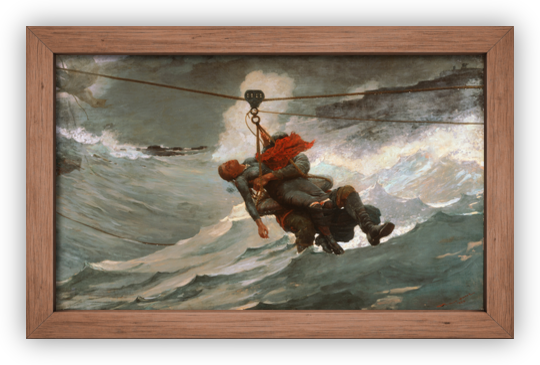 The Life Line
Here Homer places us in the middle of a sea rescue. A woman is being carried through enormous waves by a lifesaving-station man. They are suspended from a line, moving between the wreck and safety. Cox draws our attention immediately to the woman, whose unconscious body becomes the emotional center of the painting.
Look at the woman in the rescuer's arms. Her body hangs helplessly, and she appears to have fainted. Cox believed Homer deliberately concentrated our attention on her, making her vulnerability the most powerful part of the scene.
Now look at the man carrying her. His face is hidden by a woolen scarf blown outward by the wind. Cox points out that concealing his face makes our attention even more completely focused on the woman. We see his strength and determination through his posture and movement.
Follow the diagonal line stretching across the painting. The line, together with the blowing scarf and gown, creates a powerful impression of rapid movement. Cox considered this one of the painting's great strengths.
Cox admired the drama of this scene, but he also felt that the painting was not quite as successful technically as some of Homer's later work. He praised its emotional force, its movement, and its ability to capture one decisive moment in a life-and-death struggle.
-
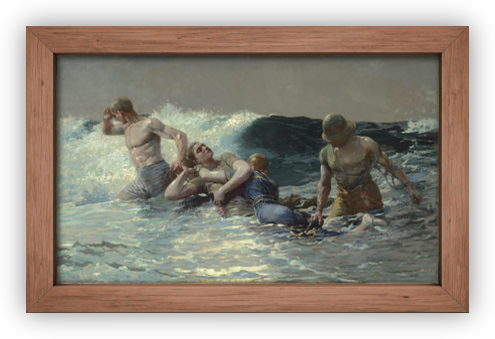 Undertow
Two men struggle through the surf, carrying two women from the water. This is a rescue scene based on an event Homer witnessed at Atlantic City. But Cox believed the painting's power goes far beyond the story itself. He considered it one of Homer's greatest achievements in figure painting.
Look at the two women clasped together. Cox was especially impressed by their figures and their proportions. He compared their appearance to classical sculpture, finding a remarkable sense of strength and beauty in the way they are joined together.
The visible face"Move closer to the face that we can see clearly. Cox compares it to Hypnos, the figure of sleep in Greek mythology. The comparison is striking. The woman's expression has a quiet, almost dreamlike quality, even as the surrounding scene is filled with danger.
Now look at the arrangement of all four figures. Cox admired the way their bodies form a connected composition. The figures are not simply placed together to tell a story. Their arrangement creates a powerful visual pattern.
Cox makes a particularly strong point about this painting. He says it would be a great picture even without its story. Its composition and figure drawing are so successful that the dramatic rescue only makes it greater.
-
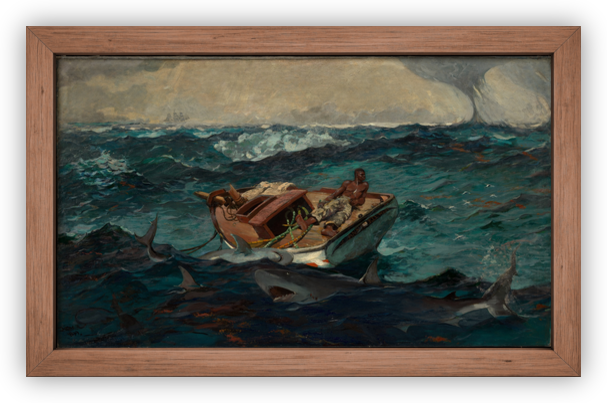 The Gulf Stream
A man sits alone in a small, damaged boat, surrounded by the open sea. Sharks move through the water nearby, and a distant ship appears on the horizon. Cox describes the man as starving and the boat as dismantled. This is one of Homer's most dramatic paintings.
Look at the man in the boat. He occupies surprisingly little space in the composition. Cox points out that the figure is small and, in his opinion, not especially well drawn. Yet the painting's power does not depend on the figure alone. The entire composition carries the drama.
Now look into the water. Cox singles out the nearer shark and the remarkable spray trailing from its tail. He describes the effect as a rainbow of spray, an example of Homer's extraordinary ability to observe and paint the details of the natural world.
Follow the lines of the boat and the ropes trailing from its bow. Cox considers these details essential. He explains that if the ropes were removed, the boat would lose its sense of helpless movement in the trough of the sea, and the sharks would seem to lose their motion as well.
Finally, look toward the distant ship. Cox specifically praises this small detail, along with the spray behind the shark. He also admired the richness and variety of the painting's blues. For him, the picture was much more than a dramatic story of survival. It was a remarkable achievement in composition, color, and movement.
-
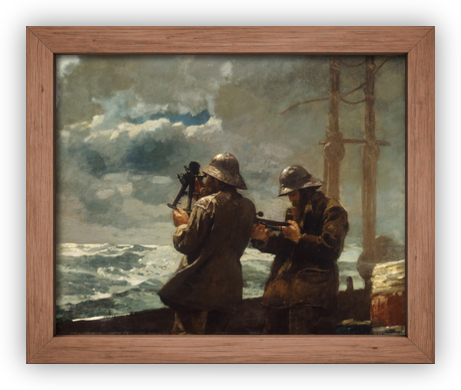 Eight Bells
Two sailors stand on the deck of a ship, carrying out a routine navigational task. There is no obvious emergency and no dramatic action. Cox calls this one of Homer's greatest sea paintings, precisely because it captures an ordinary moment and reveals its importance.
Look at the two men in their oilskins. Cox identifies them as the skipper and his mate. They are standing on the level deck, going about their regular duties. Their work is not theatrical or dramatic. It is simply part of the daily life of a sailor.
Now look at what they are doing. Cox identifies this as the taking of the noonday observation. It is a task repeated regularly aboard a ship, but it is essential to knowing where the vessel is and maintaining its safety.
Look beyond the men. Cox describes a cloudy sky, with sunlight breaking through dimly and casting a gleam across a flat but unsettled sea. The lines of the ship's cordage show that the vessel is riding on an even keel.
Cox believed the importance of this painting lies in its routine nature. He compares the sailors' work to everyday household or farm tasks. Yet this simple act is directly connected to the safety of the entire ship. In this quiet moment, he sees the whole life of the sailor.
-
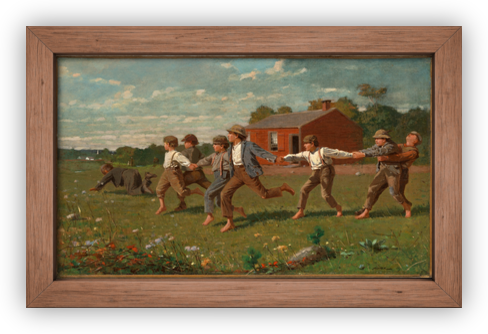 Snap the Whip
Here Homer takes us back to the memories of his boyhood. A group of boys are playing outdoors in front of a little red schoolhouse. Kenyon Cox considered Snap the Whip one of Homer's most successful early paintings, and he was particularly impressed by the sense of truth in the scene.
Look at the boys themselves. Cox says they are real boys, playing with all their might. Their movements are not carefully posed or arranged to look graceful. The drawing may be awkward in places, but the figures are full of life.
Now look at the little red schoolhouse behind them. Cox specifically praises the way Homer characterizes the landscape and its setting. The building helps make this a recognizable scene of rural American childhood.
Pay attention to the sunlight across the ground. Cox thought the color of the light was not quite convincing, but he admired how accurately Homer observed its brightness and the shapes of the shadows. He described the sunlight as hard and glittering.
Cox makes an interesting distinction. He says the painting has very little beauty in the conventional sense, yet its truth is unforgettable. Homer is beginning to express what Cox calls the glory of the outdoors, even before his mature style has fully developed.
-
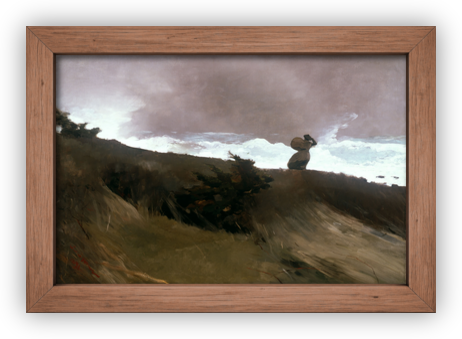 The West Wind
In The West Wind, Homer gives us a figure standing on a stretch of land above the sea. The wind seems to sweep through the entire composition. Kenyon Cox admired the painting's directness and the remarkable sense of movement created by its design.
Look at the figure standing on the land. Cox points out that the land and the figure are painted in nearly the same brown tone. Rather than relying on a wide range of colors, Homer makes the shapes and contrasts do most of the work.
Now look at the sky. Cox describes it as an opaque gray, brought down to the edge of the earth. He was not especially impressed by the color itself. What mattered to him was the relationship between the gray sky, the brown land, and the white water.
Move toward the white breakers. Cox notes that Homer uses only a few strong touches of white to describe them. Those marks are economical, but they carry tremendous force.
Cox says the rush and swoop of The West Wind comes from a few sweeping, repeated curves. He also praises the sure touch and economy of the brushwork. For him, the painting's strength lies less in its color than in its shapes, contrasts, and movement.
-
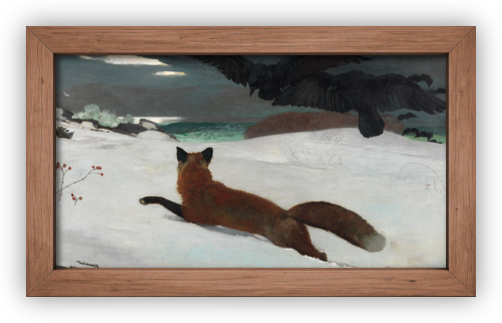 The Fox Hunt
Look at this extraordinary winter scene. A fox struggles through deep snow while a flock of hungry crows descends upon it. Kenyon Cox was fascinated by the originality of the subject. He calls it one of the most superb animal pictures in the world.
Bring your attention down to the fox. Cox points out the unusual reversal taking place here. The fox, normally a predator, is being hunted. Its speed would ordinarily give it an advantage, but the heavy snow slows it down.
Now look up at the flock of crows. Cox describes them as ravenous birds, starved by the long winter. They are pursuing a living fox through the snow. This is not simply a winter landscape; it is a struggle for survival.
Look at the relationship between the fox, the snow, and the birds above. Cox admired the way Homer turned an unexpected observation into a powerful composition. The pattern of the painting is as original as the event itself.
Cox believed Homer had an extraordinary ability to see subjects that other artists might never have thought to paint. A flock of crows hunting a fox through deep snow was one of those discoveries. Homer made it the central subject of a major work of art.
-
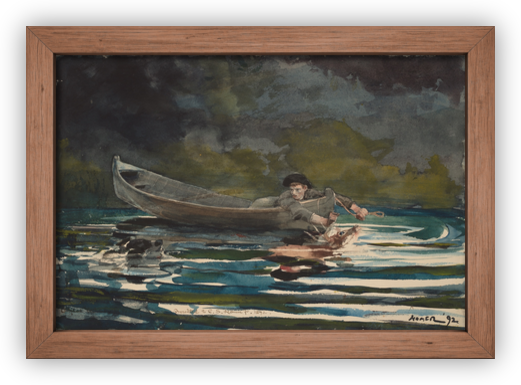 Hound and Hunter
A hunter leans over the back of a small rowboat, reaching down to grasp the antlers of a stag in the water. Nearby, a hound swims toward the boat. The scene captures the final moments of a hunt in the Adirondacks.
Look at the hunter stretched across the boat. He reaches for the stag's antlers while holding a rope in his other hand. Notice how he turns to look back toward the approaching dog.
Just below the surface is the stag. Only its muzzle, one eye, and the tips of its antlers remain visible. Homer later explained that the animal was already dead, despite the impression that it might still be struggling.
Now look at the dog swimming toward the boat. Its head is above the water, and its attention is fixed on the hunter. The bright ripples around the animals bring movement to the otherwise quiet water.
Notice how Homer brings the hunter, the stag, and the dog together in one carefully arranged scene. The autumn trees along the far bank provide a colorful backdrop to this unusual moment in the life of a hunter.
-
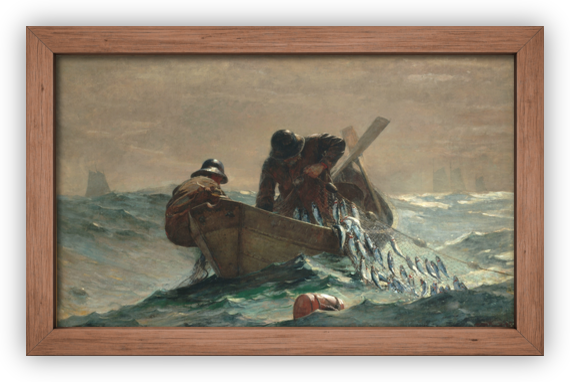 The Herring Net
 is one of two important paintings Cox identifies as belonging to Homer's 1885 series on the lives of the Banks fishermen. Like The Fog Warning, it takes us into the working life of fishermen at sea.
Look at the men working in the boat. Cox places this painting among Homer's mature pictures of sailors and fishermen, a period in which he believed Homer had become a great figure painter and an interpreter of human life.
Now look at the fish in the net. Cox specifically calls attention to the rainbow-like gleams of the fish. He considers them a fascinating part of the painting's overall effect.
Move your attention to the sky and water. Cox admired the subtle variations in their grays. He also points out the dull yellow tones of the fishermen's oilskins, describing them as true and delicate.
For Cox, the painting's strength comes from the way these details work together. The grays of the sea and sky, the yellow oilskins, and the shifting colors of the fish create a carefully balanced visual effect. He regarded The Herring Net as an important example of Homer's mature work.
-
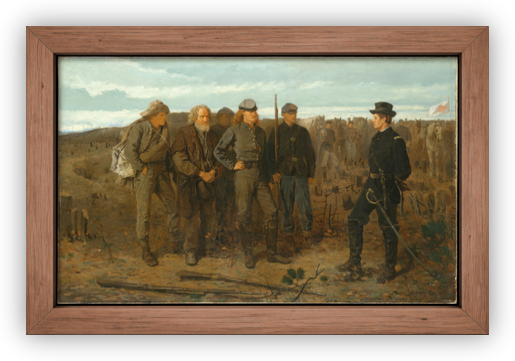 Prisoners from the Front
 was exhibited in 1866, when Homer was thirty years old. The painting made a strong impression on the art world. Kenyon Cox describes it as an important work marking the end of Homer's early apprenticeship.
The painter John La Farge later praised Homer's remarkable ability to capture a moment. Cox believed this was central to the painting's success. Rather than relying on elaborate technique, Homer chose a compelling encounter between a Union officer and three Confederate prisoners.
Cox considered the painting somewhat primitive in its execution, but recognized its importance as a major public success and a turning point in Homer's career. It would also be among his last paintings dealing with military subjects.
-
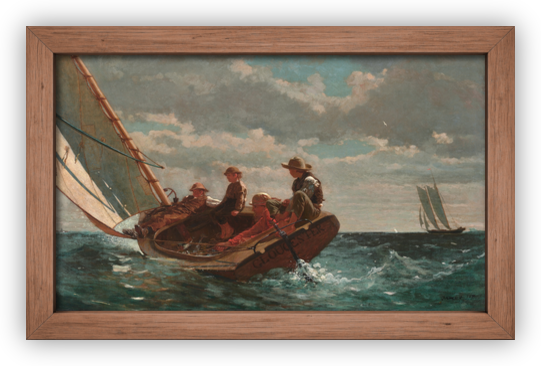 Breezing Up (A Fair Wind)
Four figures share a small sailboat on a bright, breezy day. The boat leans into the wind, the sail is full, and the water is choppy. Homer originally titled this painting A Fair Wind, describing the favorable conditions carrying the boat forward.
Look at the young man and three boys. The young man in the red shirt handles the sail with a rope. At the back of the boat, the oldest boy steers with the tiller. The other two boys sit near the bow, holding on as the boat moves through the water.
Now look toward the front of the boat. There's an anchor resting in the bow. Homer actually changed the composition during the painting's development, replacing a figure with this anchor. The National Gallery notes that an anchor is a traditional symbol of hope.
Look toward the horizon on the right. A second sailing vessel appears in the distance. Homer originally included two schooners here, but painted one out, leaving a simpler composition.
Homer completed this painting in 1876, the year of America's Centennial. The National Gallery suggests that the favorable wind, the anchor, and the boy looking toward the horizon contribute to an optimistic reading of the painting. It became an image of a country looking ahead after the Civil War.
-
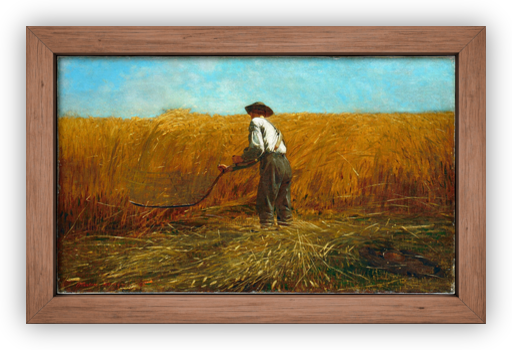 The Veteran in a New Field
A farmer works alone in a field of golden wheat. At first, this appears to be a peaceful scene of harvest. But Homer painted it in 1865, just as the American Civil War was coming to an end. The objects in the lower-right corner reveal that this farmer has another story.
Look at the man working in the field. His back is turned toward us, and we never see his face. He is swinging a scythe through the standing wheat, completely absorbed in his work.
Now look down at the lower-right corner. There is a discarded Union Army jacket and canteen. These objects identify the farmer as a returning Union veteran. He has left military service and returned to civilian life.
Look at the contrast between the abundant golden harvest and the sharp blade of the scythe. The Metropolitan Museum points out that the harvest suggests renewal and recovery, while the scythe also carries an association with death.
The title has a double meaning. The veteran is working in a new field, but he has also left the battlefield behind. Painted at the close of the Civil War, this picture brings together the hope of a new beginning and the memory of what the country has lost.
-
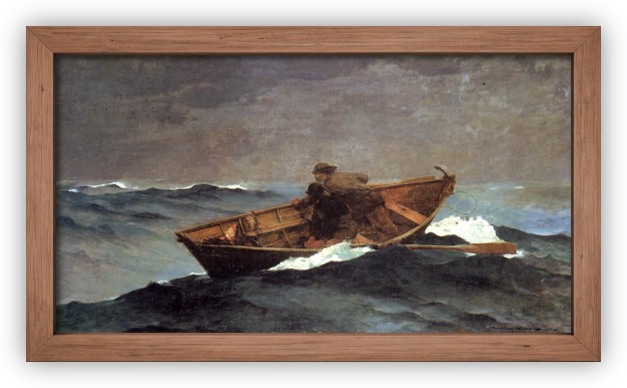 Lost on the Grand Banks
Two fishermen sit in a small dory, surrounded by the enormous North Atlantic. There is no obvious sign of rescue or a safe way home. The title tells us their situation: they are lost on the Grand Banks, one of the great fishing grounds off Newfoundland.
Look at the two men in the boat. They are small against the surrounding sea. Homer gives us no explanation of their circumstances or what happened to separate them from their larger fishing vessel.
Now look at the small boat itself. It is the only thing separating the fishermen from the open water. The Metropolitan Museum describes this painting as a stark confrontation between men and nature, with the men's ultimate fate left unknown.
Follow the water around the dory. The boat seems momentarily lifted by the swell, surrounded by an ocean that stretches beyond the edges of the painting. There is no clear indication of what lies ahead.
This painting belongs to a group of three works Homer created in 1885: The Herring Net, The Fog Warning, and Lost on the Grand Banks. Together, they explore the labor, danger, and uncertainty of the North Atlantic fishing industry. Here, Homer leaves the story unresolved. We don't know what happens to the fishermen.
-
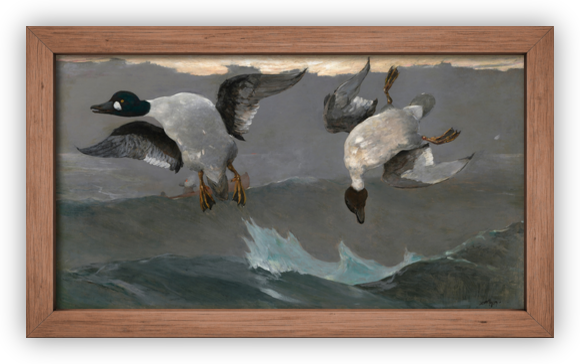 Right and Left
Two ducks are suspended in midair above a rough, gray sea. One has its wings spread wide, while the other is falling headfirst. This is a hunting scene, but Homer brings the birds so close to us that we almost become part of the action.
Look closely at the duck on the left. Its wings are extended, and its body is twisted in midair. The National Gallery in London draws attention to the bird's eye and the sense of shock in its expression.
Now look at the second duck. Its head points downward, its wings are partly folded, and its legs trail behind. The two birds appear to have been hit in quick succession.
Look beyond the birds toward the horizon. A hunter sits in a canoe, almost disappearing into the gray water and sky. A small flash of red and a cloud of smoke mark the firing of his shotgun.
The title Right and Left refers to the two barrels of a double-barreled shotgun, fired one after the other. Homer painted this near the end of his life. The National Gallery notes the painting's unsettling relationship between humans and nature, and its connection to the brevity of life and mortality.
-
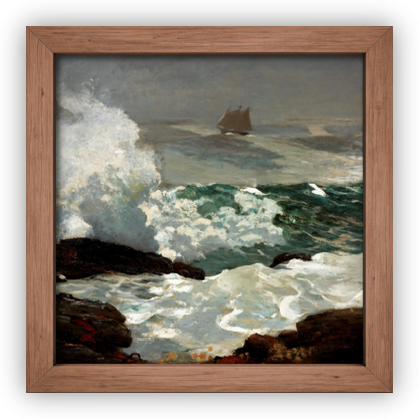 On a Lee Shore
A sailing vessel struggles offshore as enormous waves crash against a rocky coastline. The scene is dominated by the sea, the rocks, and the small vessel caught between them. The title gives us an important clue to the danger.
Look toward the distant sailboat. It appears very small against the surrounding water. The term lee shore describes a coastline toward which the wind is blowing. A sailing vessel caught in that situation risks being driven onto the rocks.
Now look at the enormous waves in the foreground. The white water breaks across the surface, creating a strong contrast with the dark green and gray sea. Homer uses broad, energetic brushstrokes to give the water its force.
Follow the dark rocks along the shoreline. They form an unforgiving barrier between the sea and the land. If the vessel is unable to turn away from the wind, it could be driven directly onto this dangerous coast.
The RISD Museum describes this painting as an expression of man's vulnerability in the face of nature. Its dark palette and forceful brushwork are characteristic of Homer's later seascapes, in which the ocean becomes the dominant subject.